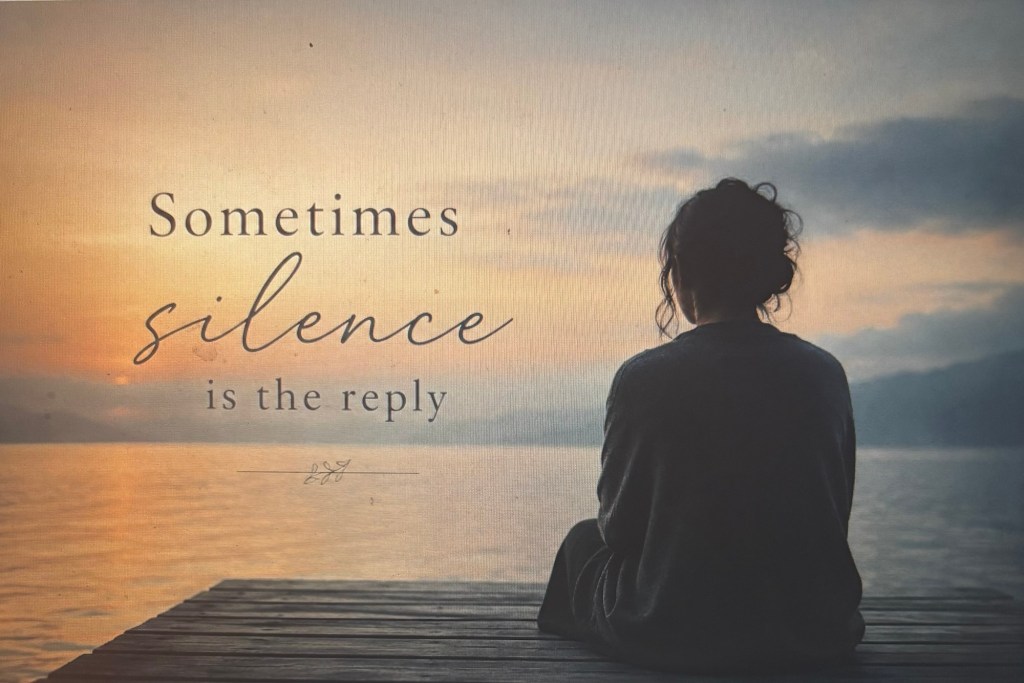
There are conversations that end with words.
And then there are the ones that end with nothing at all.
No explanation.
No argument.
No goodbye.
Just… silence.
At first, silence feels temporary. You check your phone. You convince yourself they’re busy. You tell yourself they’ll answer tomorrow, then next week, then next month. You replay the last message you sent, wondering if you chose the wrong words, the wrong tone, or the wrong moment.
You begin editing a conversation that has already ended.
The hardest part about unanswered questions is that they invite endless possibilities. Maybe they’re hurt. Maybe they’re angry. Maybe they forgot. Maybe they’re waiting for you to try again.
But after enough time passes, silence slowly changes its shape.
It stops being an empty space waiting to be filled and becomes the answer itself.
That realization isn’t bitter.
It’s heartbreaking.
Because closure isn’t always something another person gives us. Sometimes closure is realizing that someone had every opportunity to speak and chose not to.
I’ve also learned something else.
Not every relationship ends because someone is the villain.
Sometimes life changes us. Sometimes illness, grief, misunderstandings, or difficult seasons leave marks on a relationship that neither person knows how to heal. Sometimes people genuinely don’t know how to help someone they care about. Sometimes another person’s pain awakens wounds of their own, and they step away because they feel overwhelmed, uncertain, or emotionally unable to stay.
That doesn’t always mean they stopped caring.
Sometimes it simply means they didn’t know how to walk beside someone through a season they couldn’t understand.
That doesn’t make either person entirely right or entirely wrong.
It simply means the relationship could not survive the season it was in.
Healing has asked more of me than I ever imagined.
It has required me to look inward instead of outward. To ask difficult questions. To sit with uncomfortable truths. To take responsibility for the ways I may have hurt others during a time when I wasn’t well.

One of the most humbling parts of my healing journey has been coming to terms with the fact that there were moments during my illness that I simply don’t remember. I’ve had people I love gently recount conversations, words, and actions that are completely absent from my memory. Learning that I had caused pain without remembering it was one of the hardest truths I’ve ever had to face.
Not remembering is not the same as not being responsible.
Memory loss doesn’t erase another person’s hurt, and it certainly isn’t an excuse.
Healing meant accepting that even if my illness played a role in my actions, the impact on those I loved was still real.
So I did what I felt my heart needed to do.
I began what I quietly came to call my apology tour—not as a journey of shame, but as a journey of accountability. I reached out to the people I had hurt, not to erase the past or ask for another chance, but to acknowledge their pain, offer a sincere apology, and make amends wherever I could.
Some welcomed those conversations with grace.
Others chose not to respond.
I’ve learned that an apology is something we offer, not something we’re owed in return.
Forgiveness is a gift someone may choose to give.
Reconciliation is something two people must choose together.
Growth doesn’t erase the past, but it does change the person carrying it.
One of the hardest lessons in healing is accepting that not everyone will stay long enough to see that growth.
Some people know us only through our hardest moments.
Others leave before they ever witness what comes after.
And while that can hurt deeply, it doesn’t diminish the work we’ve done or the person we’re becoming.
We often think rejection arrives loudly. We imagine slammed doors, harsh words, dramatic endings.
Most of the time, it arrives quietly.
It looks like the text that never receives a reply.
The invitation that never comes.
The relationship that slowly fades without explanation.
Silence has a way of saying,
“I’m no longer able to continue this relationship.”
Those words are never spoken aloud, but they can echo just as loudly.
For a long time, I believed I needed an explanation before I could move on. I thought healing depended on hearing the right sentence from the right person.
It doesn’t.
Healing begins when we stop waiting for people to give us permission to let go.
Some people will never tell you why they left.
Some will never acknowledge your growth.
Some will never know the courage it took to face your past honestly, to apologize without expecting anything in return, and to become someone different from who you were during one of the darkest seasons of your life.
That doesn’t erase your progress.
It doesn’t erase your worth.
It simply means their chapter ended before yours did.
Maybe the greatest act of self-respect is recognizing when you’ve already received your answer, even though it never came wrapped in words.
Not every unanswered message deserves another one.
Not every closed door needs to be knocked on again.
Sometimes the kindest thing we can do for ourselves is accept the silence, grieve what we hoped the relationship would become, wish them well from a distance, and continue walking toward the life we’re building.
Because there are people who won’t make you wonder where you stand.
They’ll answer.
They’ll show up for you, even in your darkest times in your life.
They’ll see your scars without defining you by them.
They’ll recognize that healing isn’t about pretending the past never happened—it’s about becoming someone who learns from it.
And they’ll meet you where you are—not because you’re perfect, but because healthy relationships make room for truth, grace, accountability, and change.
Until then, remember this:
Silence may close a chapter.
But it never gets to write the rest of your story.
“Under skies of blue, even silence has meaning. Sometimes silence is the reply-and in that quiet, we begin to understand what words never could.”
Love,
Fran xo







Leave a comment